On November 12, leaders from across Connecticut joined legislators at the State Capitol in Hartford to discuss a topic that is becoming central to the Connecticut housing energy burden’s future: energy equity, housing resilience, and the role of home energy upgrades in Connecticut’s older housing stock. The event, hosted by Efficiency for All (EFA) and led by Representative Jonathan Steinberg, marked a release of EFA’s M=Power 3.0 policy platform. It also served as a direct call to align policy, workforce development, and community needs under a unified strategy in CT’s energy and housing sectors. The Connecticut housing energy burden refers to the share of household income spent on energy costs, a figure that exceeds 18 percent in many environmental justice communities across the state.
The briefing was attended by legislators, contractors, nonprofit leaders, and residents who have benefited from the M=Power program. Each speaker described a different piece of the same puzzle. CT’s older housing stock, aging infrastructure, and concerning dependence on natural gas leave thousands of the state’s families with high home energy costs in Connecticut, unsafe indoor air, and avoidable health risks. Many of these households live in environmental justice (EJ) communities, where energy burden in CT often exceeds 18 to 22 percent of household income.

The Connecticut Housing Energy Burden and Housing Conditions
Unsurprisingly, CT has some of the highest residential energy costs per household in the United States. Based on data cited during the briefing, over 320,000 CT households face an annual affordability gap of about $1,400. This margin demonstrates the difference between what a family can reasonably afford to pay for energy and what they are paying. While many CT households may meet these bills on paper, they do so by sacrificing food, medication, transportation, or rent.
In EJ zones and financially distressed municipalities, this problem is amplified by structural issues like mold, poor ventilation, unsealed attics, broken bulkhead doors, and outdated heating and ventilation systems. These residents are forced to spend more to heat and cool their homes because the building envelope leaks, raising their energy burden. In homes built before 1920, walls function like open chimneys, pushing warm air straight into the attic and pulling in cold air from basements and crawlspaces, conditions that directly undermine the performance of modern HVAC and heat pump systems in Connecticut.
Representative Steinberg reiterated that energy equity is far from a theoretical concept. It is a measurable problem that has been proven to affect education outcomes, respiratory health, workforce participation, and long-term housing equity and stability. While CT has made progress expanding heat pumps, energy efficiency incentives, and renewable energy programs, the underlying condition of the home determines whether these technologies will actually reduce demand.
How the M=Power Model Addresses Energy Burden in CT
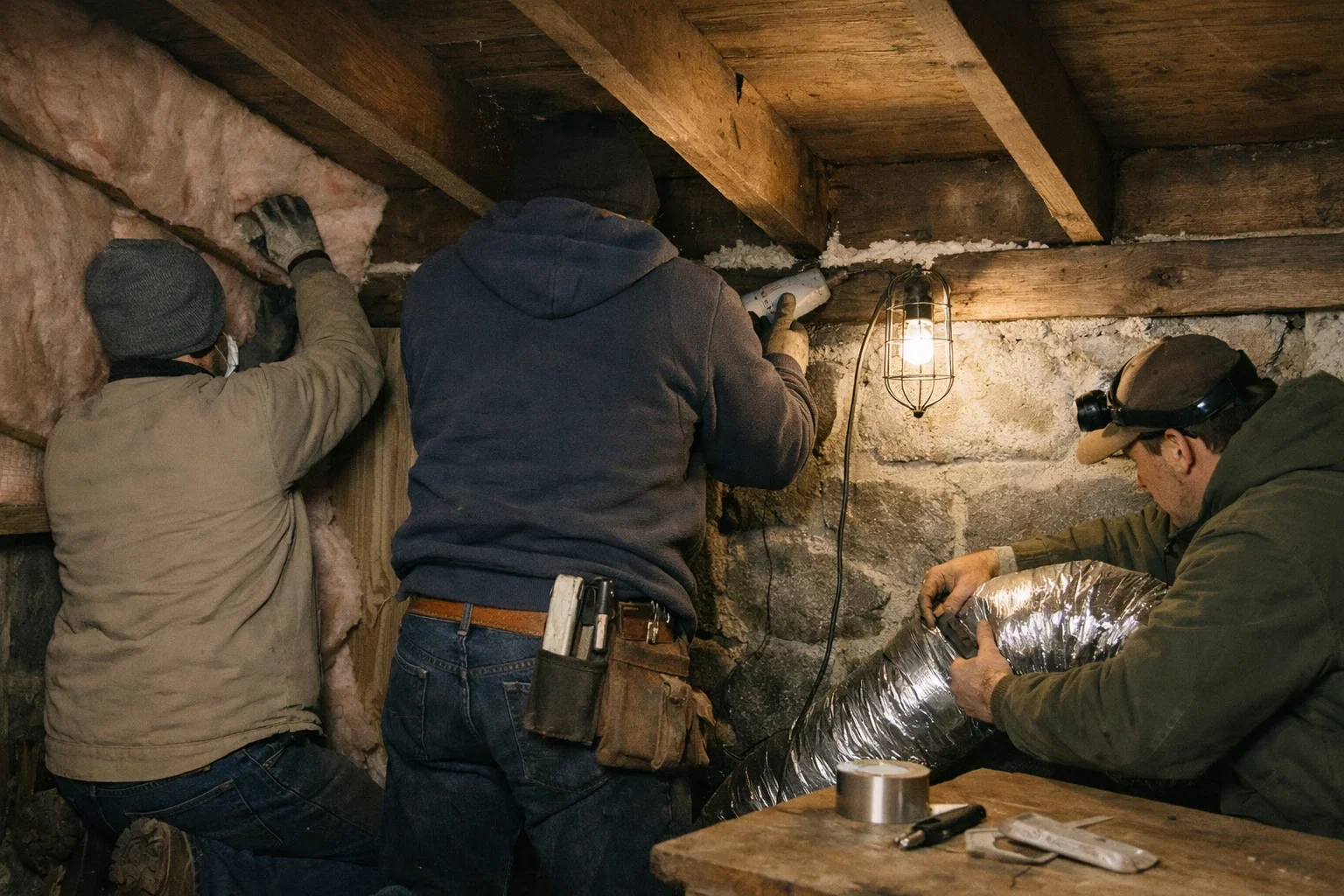
At the hearing, EFA leaders described their M=Power program as a “hand up, not a handout.” The program is designed to train residents from some of CT’s most disproportionately affected EJ communities for energy efficiency careers in Connecticut and then deploy those trainees back into their own neighborhoods to perform retrofits. The approach avoids the traditional “helicopter in” contractor model and preserves both economic and social value within EJ communities.
EFA’s flagship, M=Power 1.0, trained over 200 CT residents and supported retrofits for over 17,000 homes throughout the state. The 2.0 predecessor in New Haven focused on the New Hallsville neighborhood, demonstrating how deep building improvements can change household finances, indoor air quality, and long-term housing stability. Within every home evaluated, insulation and air sealing were assessed. In many, moisture and mold problems were identified, and several had potentially harmful heating and ventilation failures.
These interventions were both significant and targeted: air sealing, cellulose insulation, ventilation upgrades, HVAC improvements, and in some cases triple-pane windows. The results were measurable, reductions in energy demand, lower bills, and safer indoor environments. Some residents, including elderly homeowners, reported significant savings and improving health issues caused by mold exposure.
Governor Ned Lamont acknowledged that CT’s clean energy goals will hinge on this kind of direct investment in EJ communities. He noted that energy efficiency upgrades have a dual benefit: reducing household costs while cutting emissions in the neighborhoods that often experience the highest pollution levels.

What M=Power 3.0 Expands Across Connecticut
M=Power 3.0 is designed to expand the program to all 27 EJ zones across CT. The model remains consistent and continues to assess each home from the “frost line to the ridge line.” Speakers described its potential to overcome barriers to participation in Connecticut energy incentive programs, train local workers to deliver improvements, blend state, federal, and utility funding, and measure results through reduced demand, healthier housing, and local job creation.
The program also offers a complementary initiative called Power Our People (POP), which aims to expand solar access for Connecticut households historically excluded from renewable energy incentive programs. POP would provide enough solar capacity to cover the average CT household’s base load and generate long-term savings. Combined with weatherization and HVAC upgrades, this produces a more resilient grid and improves affordability.
Scaling the program will require a mix of bonding, federal resources, and coordination through agencies such as the Department of Housing and the Department of Energy and Environmental Protection. Presenters emphasized that M=Power is as much an economic strategy as a climate strategy. When retrofit programs reduce mold, improve ventilation, and lower indoor pollution, CT taxpayers save money on healthcare and infrastructure costs. Reduced demand also minimizes peak grid strain, while healthier housing supports workforce participation.

Where CSC Fits In: Education, Equity, and Sustainability in CT Real Estate Practice
Creating Sustainable Communities (CSC) supported the briefing because CSC’s work intersects directly with the issues outlined in the M=Power hearing. Energy equity, fair housing, and environmental justice in Connecticut real estate now shape the daily work of real estate professionals. Agents routinely advise clients on homes that require retrofits, are located in EJ zones, or face long-term operating cost challenges tied to energy performance.
CSC provides on-the-ground services like sustainability gift cards for homeowners, recycling and waste-reduction services, and structured sustainability-driven education for realtors. Courses cover energy burden, EJ mapping, sustainable marketing, green disclosures, and climate-informed ethics, practical knowledge that brokers and agents increasingly need as clients ask more questions about home energy performance in CT.

Frequently Asked Questions About Connecticut’s Housing Energy Burden
What is the housing energy burden in Connecticut?
The housing energy burden measures the percentage of household income spent on energy costs. In many Connecticut EJ communities, it exceeds 18 percent.
What is M=Power 3.0?
M=Power 3.0 is a statewide expansion of a community-based retrofit and workforce development model designed to reduce energy burden and improve housing conditions.
Why does housing condition matter for energy equity?
Older homes with poor insulation, ventilation, and air sealing increase energy demand, undermining the effectiveness of modern energy technologies.
Moving Forward
The Capitol briefing made one thing clear: CT cannot reach its climate, housing, or public health goals without addressing the condition of homes where residents live. Retrofits, workforce development, and expanded access to clean energy must be integrated. The M=Power 3.0 platform provides a model that is proven and ready to scale.
CSC will continue supporting this momentum by providing real-world sustainability access to real estate professionals through education and services that make prioritizing CT’s climate and communities while reducing the Connecticut housing energy burden mutually beneficial. This empowers realtors to better serve their communities, one home at a time.
If you want to go deeper:
- For the buyer-side experience of these incentives, see The Quiet Power of a Warm Room.
- To understand how statewide incentives support healthier homes, read EnergizeCT’s Bigger Purpose.
- For a grounded look at how these upgrades appear in valuation, explore How Energy Features Affect Home Value in Connecticut.